Background
Indonesian economic in 2014 may
possibly be at down turn,
economic growth decline since 2012 -2013 which was at 6.3 and 5.8
consecutively. Accordance to bank mandiri, the economic growth of indonesia
will be at 5.1 in 2014. Based on data at the central bank, Economic growth of
third quarter is at 5.1 %.
The decline of economic growth
might be caused by the economic slow down of emerging market such as india and
china and also the hike of price level as government allocated fuel subsidy to
other sectors.
Government allocated its subsidy
for fuel and allocated it to several productive posts such as infrastructure
and also fund for social security.
The inflation rate will be rise
as the price of gasoline increases up. In other side Government spending will
be higher as the its allocation of subsidy to others sectors. The inflation
rate is predicted at 6.5 – 7.5.
In short run
Aggregate demand will decrease and real GDP will decline, in order to keep
better real GDP equal potential GDP, the allocation program has to be
implemented as soon as possible.
Meanwhile the fed will increase
its interest rate, the fed will reduce its money supply and they will sell more
Treasury bill. Foreign capital may be removed out from indonesia in huge
amount. The currency rate will be hit by the Fed’s policy which plans to rise interest rate in second quarter of next year.
Central Bank has increased
interest rate at 7.75 % to reach its target of inflatiion rate. That means the
central bank reduces the
currency in the market. The currency rate will be expected at stable exchange
rate to US dollar as the increase in interest rate of goverment bonds.
The positive news is the decrease
of Global oil price that is expected reducing cost for importing crude oil. Based on Bloomberg in November 2013,
oil price decline 30 %, demand of crude oil is slowing down and several
industries seems start to use substitute product such as natural gas, solar
energy,shale gas and
coal etc.
The weaken currency will be an
opportunity to increase export sector. As the source of various commodities
indonesia has opportunity to export commodity with cheaper price even though
the bank will rise interest. The strategic industry related to export oriented may need
lower financial cost to advance export. Government might give particular incentive such as tariff, quota and tax
in order to increase export as operational cost climbs driven because of
allocation of fuel subsidy.
Politics and Government
The government under president of Jokowi has
programs in agriculture, infrastructure and social security. Government plans
to build many water dams for plantation and farming and to open irrigation.
Another program is at maritime industry. The sector related to its sectors may increase significantly during
Jokowi administration.
The big concern is at the stability of politics
situation. As long as parliament still has either internal conflict or external
conflict there is no guarantee the politics circumstances will support the
economic situation. According to Bloomberg news, 38 % of government bond is
owned by investor from oversea that means rupiah exchange rate is likely affected
by investor from abroad who is sensitive to political situation.
Parliament is owned by the opposite parties as
they are the major part of parliament. The parliament plans to use its
interpellation right to ask the government about the allocation of fuel
subsidy. The politics situation may possibly be worse. Government needs support
from the opposite parties, as they power more than 50 % of votes.
Petrochemical Industry
Expert said that this sector as
the mother of industry because it contributes to give input to various
industries such as automotive, textile, food and beverage and etc. In
indonesia, petrochemical industry is still lack of investment because it needs
much more fund to establish integrated petrochemical industry such as
petrochemical refinery, olefin industry and etc.
Olefin as potential market
Olefin is the most demanded raw
material in petrochemical industry at Indonesia. Olefin could be extracted in
to various products such as polyethylene, polypropylene, styrene monomer and
etc. These products could be used to produce many kind of product in downstream
industry. These are plastic bags, bottles, food containers, automotive parts,
tires, synthetic rubber, fibers and filaments and others consumer product.
Although the demand of olefin
product has increased, the supply of chemical product is not able to capture
the opportunity. The upstream petrochemical industry is not capable yet in
serving domestic demand. There are two biggest companies in upstream industry
of petrochemical which produce olefin, Pertamina and Chandra Asri centre.
Olefin is a downstream product
which is having strategic value because of its derivative product is used in
many industries.
The stumble in enhancing olefin
production is the availability of naphta in indonesia. Naphta is a derivative
form of crude oil. 90 % of cost of production in producing olefin is spent for
purchasing naphtha. This is useful to breakdown the chain of hydrocarbon. In
almost every year indonesia Imports 2 millions tones of naphta for domestic
industry.
The lack of naptha supply for
olefin industry is caused by less investment in petrochemical refinery in
indonesia. The high demand of crude oil for fuel product and the decline of oil
reserve in indonesia are affected the supply of naphta. This circumstance
insists the industry player import the naphtha from another country. The cost
is very affected by the fluctuation of foreign exchange rate which is used to make
decision in investing fund for purchasing naphta.
In other side the industry is
also having problem in capacity of production, especially for ethylene and
propylene. The capacities of those are below the domestic demand. Its
capacities are 600,000 tones and 865,000 tones while the demands are 1.04
million tones.
In 2015, few companies will
increase the capacity of production; they are joint venture of pertamina - PTT
Global chemical and Chandra Asri Petrochemical.
Chandra Asri Petrochemical is the
only producer of ethylene, styrene monomer and butadiene in domestic. The
company is also one of two producer of polyethylene and one of three producer
of polypropylene in indonesia. Chandra Asri has 50 % market share for
polypropylene and has 30 % of polypropylene’s market share in domestic. (annual
report).
The opportunity in olefin
industry and its derivative product is still promising for investor because the
main player in its business is small in number and its capacity is under the
domestic demand.
CHANDRA ASRI PETROCHEMICAL
Strong Capital access
The company is established in 2011, it is new
company which was formed from a merger between two companies, Tri Polyta and
Chandra Asri. This is owned by several conglomerates group, they are salim,
ciputra and prayogo pangestu’s family,
The Majority shareholder is PT Barito Pacific
with 55.36 % of total share. The biggest contribution to sales is Polyolefin
product, which is at 50,86 %of total revenue.
The other products are Styrene Monomer, Olefin and Butadiene. 75 % of
total revenue is contributed from domestic market and the rest is from export.
The company also has strategic partnership with
international company such as Michelin for synthetic rubber production and Basf
for production license.
Capital Barrier to new
entry and high Plant Capacity utilization rate
The barrier for new entry in this industry is
huge investment amount for establishing the business. The company has big market share in
indonesia. Accordance to its annual report the company has used its capacity
almost 90 % in average. The demand in 2013 is still high and I think the
company will have strong demand in 2014 as the competition in olefin production
is low.
The average of capacity utilization is also high;
the demand in the market seems strong. The average of its utilization is 91.8
percent. The lack in this industry is limited supply of naptha, it is fully
imported from abroad.
Chandra Asri Petrochemical is the
only producer of ethylene, styrene monomer and butadiene in domestic. The
capacity of production is still below the domestic demand.
Global Oil price and
inflation rate
naptha as the main raw material of the company
declines in its price as the oil price decreases more than 30 % compared to the
previous years. The company may reduce its cost of goods sold and it is
expected increase profit. The decline of rupiah currency is expected exceed by
the decline of oil price. As long as wages do not highly increase, the downward
of oil price can be a good momentum to increase net income.
75 % of total revenue is contributed from domestic
market, which means the biggest income is in local currency. The energy price
is also higher caused by the allocation of oil subsidy by government; other
costs which hike are transportations.
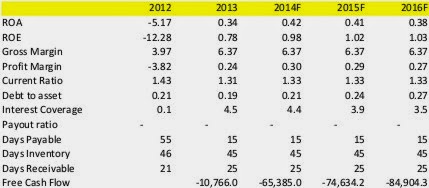
In 2013 the revenue has advanced 9.7 % up
compared to 2012. The company has expanded its business segment in butadiene
segment. The profit rises sharply and so did the gross margin in 2013 compared
to 2012.
The activity ratio is better in 2013 than
2012, with good market share and
low competition in domestic, the company will grow in the next 3 years.
My assumption, the sales will grow more tha 10 % as the inflation rate
advanced. The capacity of production is beneath the demand, the company should
add new factory or equipment to increase production.